U.S. data center research

Find data centers. Check the evidence.

Search U.S. data center projects, companies, places and public claims. Listings from a licensed directory and from operators’ own websites are leads to investigate, not necessarily distinct data centers.

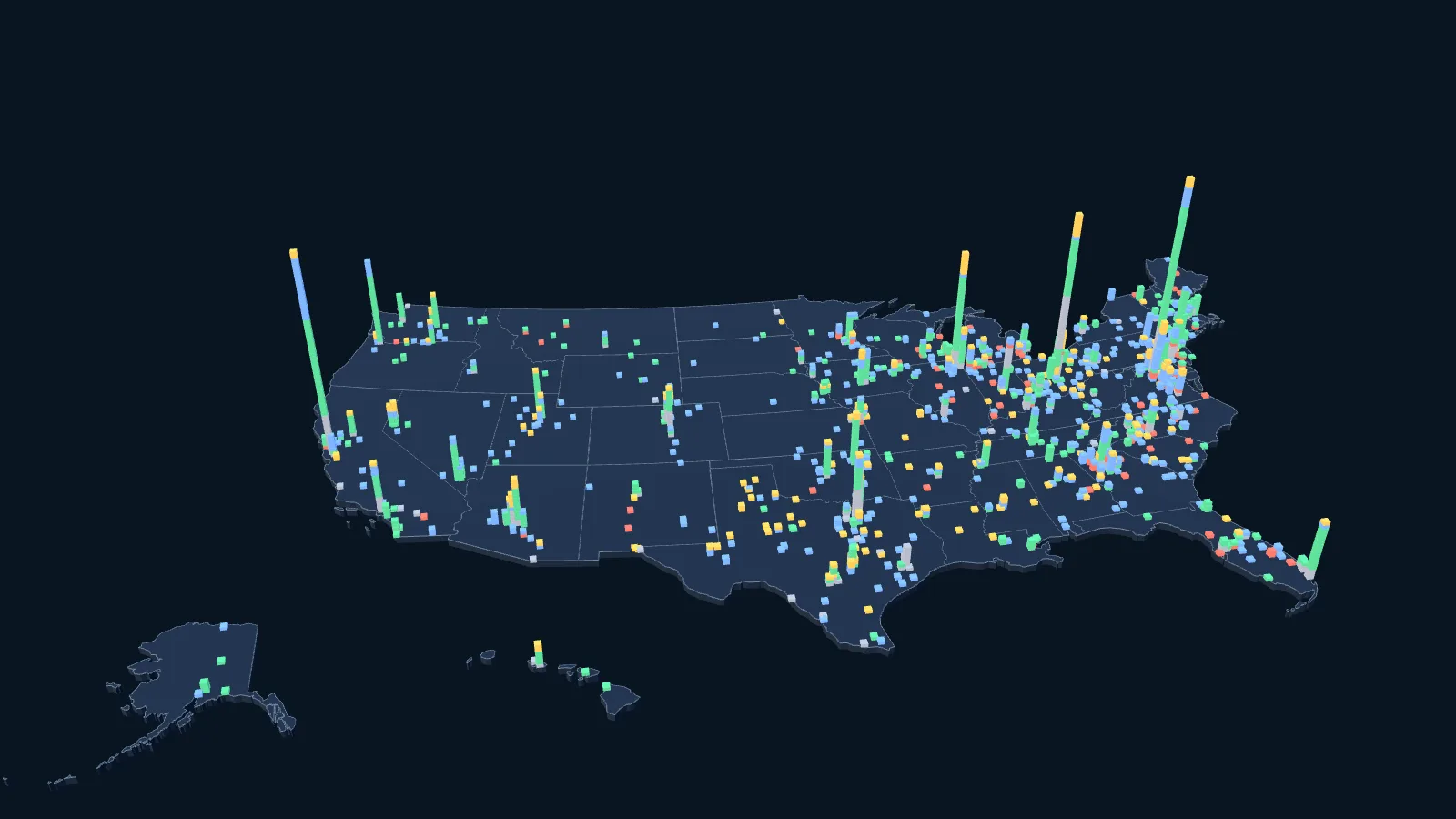
A dark 3D map of the United States with small colored blocks standing on it, one for each source listing. They stack highest around northern Virginia, Silicon Valley and central Ohio.Open the 3D map

Explore in 3D

Explore 3,115 data center source listings, 2,199 mapped in 3D

Turn it, zoom in and search by name, operator or town. Color it by stated status or by source. Pick a public company and see where its listings stand, or see where voters decided on data centers on 3 November. Then walk through a model data center, part by part.

One block is one source listing, not one verified site. Listings can repeat the same place. Compute-infrastructure data from Compute Atlas by Edward Kubiak (CC BY 4.0), source as of 14 October 2026.

For your community

What would a data center mean here?

Pick a question: what public records show, real examples with their sources, the common misreading, and the documents to ask your officials for.

Will our electric bills go up?

There is no single yes or no. Who pays depends on the utility’s rules for very large customers and the contract that serves the project. Virginia’s 2024 legislative review found data centers were then paying their full cost of service, but warned that future growth could raise other customers’ costs.

What the records show

  1. Utah · State law, 2025

    Where a qualifying utility serves a new customer expected to reach 100 megawatts or more within five years, under a contract starting service by the end of 2034, that customer must pay all the extra costs of serving it. Which data-center contracts have been filed under the law is not yet known.

    Sources and limits · checked 1 November 2026

  2. Kansas · State law

    A qualified data center cannot get the state’s economic-development discount on electric rates. The law does not say what any data center pays.

    Sources and limits · checked 6 November 2026

Common misreading

A tariff is not a bill. Approving a contract or passing a cost rule does not show what households will actually pay.

Documents to ask for

Ask your utility and your state utility commission for:

  • The large-load tariff or special contract that will serve the project, with its minimum bill, minimum term and exit fee
  • The commission docket where that contract, and any new generation or transmission costs, are decided
  • Whether the cost-benefit workpapers in that docket are public or redacted
  • Who pays if the project leaves early

How much water will it use?

Announcements often leave this out. The figures that do appear measure different things: a permit, a contract ceiling, an estimate or a metered amount. “Closed loop” cooling can recirculate and still need make-up water.

What the records show

  1. Quincy, Washington · EPA case study

    A city-operated reuse system began serving Microsoft’s campus on 30 June 2021. EPA estimates it saves 138 million gallons of drinking water a year and reports about 260 million gallons a year of canal water used as make-up. Those are EPA’s dated estimates of different measures, not total or current use.

    Sources and limits · Case study · checked 12 September 2026

  2. West Des Moines, Iowa · Water utility board item, 2024

    The agreement form caps Microsoft’s combined peak-day use at five million gallons a day across six sites. It calls that a ceiling, not a guaranteed amount, and gives no figure for actual use.

    Sources and limits · checked 1 November 2026

Common misreading

“Closed loop” is not a complete water answer. A permitted amount is not use, and estimated savings are not consumption.

Documents to ask for

Ask for the numbers “closed loop” does not provide:

  • The permitted withdrawal
  • The metered purchase or use
  • The source of make-up water for cooling
  • Any discharge permit, remembering that a permit is permission, not a measured discharge

How many jobs will it bring?

Construction can employ large temporary crews; the finished building usually needs far fewer people. Industry representatives told Virginia’s 2024 review that a typical 250,000-square-foot facility has about 50 full-time workers, roughly half of them contractors, against about 1,500 at the peak of a 12–18 month build.

What the records show

  1. Illinois · Economic study, 2026

    A headline of roughly 121,000 projected jobs combines 112,950 construction job-years over 2026–2035 with 7,998 yearly operations-related jobs projected for 2035. A job-year is one job for one year, not a different person.

    Sources and limits · checked 12 October 2026

  2. New Carlisle, Indiana · State baseline and company account

    The state set a baseline of at least 1,000 jobs. AWS’s own July 2026 account says nearly 1,000 operations staff were hired; that is the company’s figure, not yet checked against the county compliance filing.

    Sources and limits · Case study · checked 11 September 2026

Common misreading

A peak construction headcount is not permanent employment, and a job-year is not a worker. Contractors on site may not appear in the operator’s own count.

Documents to ask for

Ask for four numbers separately, then the filing that tests them:

  • Peak construction headcount, with its date
  • Job-years from any economic impact model
  • Direct permanent employees on the operator’s payroll
  • On-site contractors
  • The annual compliance filing the county uses to test the permanent number (Indiana calls it the CF-1)

What will our town actually collect?

Start with taxes and payments actually received, then subtract public costs such as roads, substations, water and staffing. An incentive’s announced ceiling is not the amount paid out, and a tax exemption does not mean a project pays no taxes.

What the records show

  1. New Albany, Ohio · City finance page, tax year 2024

    The city’s $178 million figure for one hyperscaler is a “payroll equivalent”: the payroll that would produce the same revenue at its 2% income-tax rate. It is not wages paid or a headcount.

    Sources and limits · Case study · checked 12 September 2026

  2. Indiana · State incentive records, 2024–2026

    The state authorized up to $98.3 million across four credit and grant programs for AWS’s New Carlisle campus, plus a separate sales-tax exemption. When checked on 12 September 2026, the state’s records showed $0 paid or certified on the largest program, $55 million.

    Sources and limits · checked 12 September 2026

Common misreading

An authorized ceiling is not a paid amount, and an exemption term is not a receipt. An investment announcement is not completed investment.

Documents to ask for

Ask the town or county for:

  • The executed development agreement or PILOT (payment in lieu of taxes)
  • The council minutes that approved it, with page numbers
  • The receipts actually collected each year, not the announced face value
  • The public costs: roads, substations, water and staffing, net of what the developer pays

Can our town pause or limit it?

Some have. Towns, counties and states have adopted moratoriums, restrictions and permit pauses; other proposals failed or are still pending. Each policy record here gives its exact scope, dates and source.

Moratoriums and pauses in effect now: 53 across 23 states →

Newest local pauses in effect

  1. Local pause · effective 19 October 2026

    City of Cleveland, Ohio: standalone data center permit pause extended to 29 January 2027 (Emergency Ordinance 1246-2026)

    Marked in effect when checked 30 October 2026

  2. Local pause · effective 15 October 2026

    Unincorporated Johnson County, Iowa: data-center approval pause extended to 8 August 2027

    Marked in effect when checked 25 October 2026

  3. Local pause · effective 7 October 2026

    Joyfield Township, Michigan: 12-month moratorium on data center and crypto mining approvals (Resolution 2026-07)

    Marked in effect when checked 1 November 2026

Common misreading

Check exactly what a pause covers and when it ends. Many local pauses stop new applications, and many have a set end date.

Documents to ask for

Ask your town or county for:

  • The ordinance or resolution text, with its exact scope and end date
  • The zoning rules that would apply to the site
  • Agendas and minutes for the planning commission and council meetings where it comes up

Is it really going to be built?

An announcement, a land-use vote, a power approval and a building permit are separate steps. None of them alone shows that construction has started or that a data center is operating.

What the records show

  1. Hammond, Indiana · City notice, July 2026

    The city says the agreement for a proposed CoreWeave expansion expired. That does not mean the existing data center at the site closed; its current operating status is not freshly confirmed.

    Sources and limits · Case study · checked 11 September 2026

  2. Weld County, Colorado · County commissioners, 2026

    Commissioners voted 5-0 on 9 September 2026 to approve land use for a data center in an existing industrial facility near Windsor. The county says the applicant still needs all required permits before construction, which may include building, electrical and fire permits.

    Sources and limits · checked 21 September 2026

Common misreading

A permit is permission, not proof of construction. An approval is not operation, and a project lead is not a building.

Documents to ask for

Ask the county, the city and the utility for:

  • Building permits and their inspection status
  • The land-use or site plan approval, with its conditions
  • The signed electric service agreement, or the status of the grid connection request

Not covered yet: Air permits, wetlands, land disturbance and noise have not yet been checked.

Find your state’s recordsAll evidence briefsEvidence & answers